Have you thought about

checking our FAQ ?

Who can benefit from the NFI services?

4 specific cases:
  • Foreign companies in all sectors looking to expand in Hauts-de-France
  • French companies with no site in Hauts-de-France
  • Hauts-de-France companies with a succession plan
  • Foreign-owned companies in Hauts-de-France with a development project
Our services are not intended for :
  • French or international self-employed entrepreneurs
  • French companies wishing to export
  • International companies seeking distribution networks only

Why as the help of Nord France Invest?

Nord France Invest provides you with completely tailored, free of charge and confidential support. We centralize all the information you need to analyze your project. We facilitate your process to find a site, partners or land. We organize site visits. We accelerate your networking with future regional partners. Find out more about the agency's services on this page.

What type of project can support you in?

The agency supports job-creating investment projects. The nature of projects varies according to 3 main categories:
  • Start-up projects
  • Expansion of existing sites in the region
  • takeovers of regional businesses by international companies.
Nord France Invest's services are not aimed at capital investments.
Check the FAQ
Contact

Do you have an expansion project?

Leave us your contact details and we’ll get back to you by e-mail.

This field is for validation purposes and should be left unchanged.
Top !
Home»success stories»TMMF, Toyota’s “Made in France”

Toyota Motor Manufacturing France

“Made in France” by the Japanese manufacturer

Established in Hauts-de-France since 1991, the Japanese Manufacturer built the foundations of national success in the region and become the leading automotive manufacturer in France in 2022. Review of this return on investment for Toyota with Rodolphe Delaunay, its CEO.
Date de publication Published on 29.06.2026
Nord France Invest

Toyota, 25 years of development
in Hauts-de-France

Toyota is the world leader in the automotive industry for the fifth year running, bringing 10.8 million cars to the market in 2024.

The manufacturer has 73 production sites and set up its first French plant in 19991 in Onnaing, near Valenciennes, in the Hauts-de-France region.

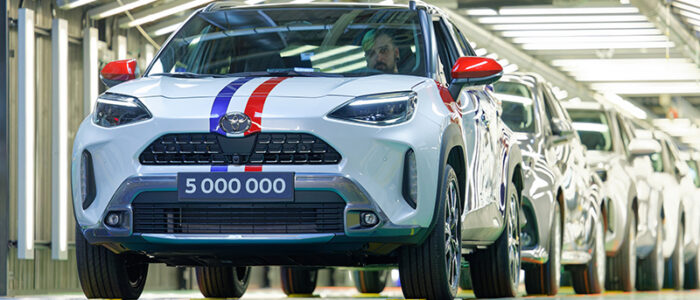
The plant far exceeded the five million cars planned and has been the leading automotive manufacturer in France since 2022.

Alongside Renault (Douai and Maubeuge) and Stellantis (Hordain), Toyota (Onnaing) completes a triumvirate of industrial sites that make the Hauts-de-France region France’s leading automotive hub (in terms of the number of vehicles produced).

🔎 Find out more about the strength of the regional automotive industry

Our region is home to nearly half of French production, a fact it owes mainly to the Japanese manufacturer, which is the biggest private-sector employer in the region, with 5,000 staff.

This achievement is the result of a €1.5-billion investment made in several phases. In addition to the costs of creating the site, TMMF released €450 million in 2020 to add manufacturing lines for the new Yaris and Yaris Cross models. The French plant has focused on the hybrid market—which accounts for all its current production—while electric cars in the Toyota range are made in Japan. However, it is not ruling out new developments in production and has 800,000m2 of land reserves available to this end, constituting an opportunity to further enrich the automotive culture in Hauts-de-France and reinforce its leadership in the sector. Besides the presence of its three manufacturers, our region is home to a dense network of equipment manufacturers and subcontractors, not to mention its Battery Valley and multiple gigafactories.

A look back at this return on investment with the company’s CEO, Rodolphe Delaunay.


1 Date of the start of work, with inauguration and the launch of production in January 2001.

The support we received in the Hauts-de-France region was truly outstanding.

Rodolphe Delaunay, President of Toyota Motor Manufacturing France

Can you remind us of the context
in which Toyota set up in Valenciennes?

In 1977, to counter the rise in sales of Japanese cars on its territory, Europe imposed a quota to limit the proportion of Japanese car imports, which in France was set at 3% of national registrations1.

By choosing to create Toyota Motor Manufacturing France in Valenciennes, even though the brand only previously had a commercial presence there, our company was able to increase its market share in Europe.

Toyota also has the characteristic of manufacturing its vehicles in the same region of the world where it sells them, something we refer to in-house as ‘best in town’.

That is why we have 73 factories across the globe.

We have a dedicated team for this, which constantly travels the world to seek out future sites.

1An agreement signed in the early 1990s ended this strict quota and planned for a gradual increase in importations. The measures came to an end with the full opening of the European market and the expansion of local production by Japanese manufacturers in Europe.


Originally, Toyota Valenciennes aimed to produce 150,000 vehicles with 2,000 employees. 25 years later, we have 5,000 staff and 500,000 vehicles rolling off the production line.

Rodolphe Delaunay

What were the determining factors
in the choice of Valenciennes and Hauts-de-France?

There were many places that could have hosted us.

Different sites were considered based on specific criteria, bearing in mind that Shoichiro Toyoda, then President of Toyota Motor Corporation, enjoyed visited France, which was seen as the birthplace of the automotive industry.

He met his counterparts and exchanged regularly with Jacques Calvet, in particular to ascertain whether we would be welcome should a factory plant be set up for small city cars.

The agreement of the iconic CEO of Groupe PSA Peugeot-Citroën at the time was a determining factor, as was the involvement of Jean-Louis Boorlo, then Mayor of Valenciennes.

We received outstanding support embodied by a dedicated contact: a sub-prefect who greatly facilitated exchanges with everyone concerned.

Although the Japanese decision-makers were initially worried about French bureaucratic red tape, they were soon reassured, including by the adoption of the 35-hour week, which raised no major issues since the measure had been incorporated from the creation of the activity.

🎤 Interview: Caroline Barbe, partner and labor law specialist at Solucial, talks about the flexibility of work in France

From local to regional level, business leaders in Hauts-de-France are united and contribute unanimously to investment and industrial development. For Toyota, this collective mobilization is a real source of added value.

Rodolphe Delaynay

Economic stakeholders consider that there was a before and after Toyota.
Can you explain that?

The Toyota culture is unique.

Some manufacturers try and copy us, but none truly succeed.

One of the reasons is the unusual relationship we have with our suppliers, who see us as partners in our own right.

We support them through their development and as part of a long-term collaboration.

There is no question of threatening them by pressurizing them with every contract to make them lower their prices, saying, “Watch out, there’s no certainty you’ll get the next project.”

We contributed very actively to the arrival of certain companies in the region, such as Toyotas Bushoku Corporation, our subsidiary that set up in the former Faurecia plant in Somain in 20028, and Toyota Tsusho Europe and Toyotomi Europe, which are based in Onnaing (59).

These companies are an integral part of the Toyota galaxy.

What makes you stress the importance
of proximity with your suppliers?

We believe that productivity requires responsiveness, and therefore a short supply chain.

🔎 Optimize your logistics in Hauts-de-France

In this respect, we aim to build a network of local suppliers.

Since Covid, transport costs have exceeded the price of certain parts.

Countries such as Great Britain are experiencing a shortage of suppliers, who tend to set up in the Maghreb.

In addition—and unlike other manufacturers who subcontract most of the production of their vehicle parts—we have incorporated the production of our front and rear bumpers and dashboards.

This strategy is an integral part of Toyota’s DNA.

What are the main characteristics
of the TMMF plant in Valenciennes?

First and foremost, the plant is the largest and most productive of the Toyota factories in Europe, which currently number six.

It is also the one that produces the most vehicles in France.

After 25 years of existence, our site is intrinsically linked to the Valenciennes area and its image.

We employ 5,000 staff and contribute significantly to the life of the local area.

In 2024, our corporate tax bill was €50 million, which gives an idea of our financial contribution, in addition to a strong social dimension: partnerships, sponsorship, patronage, relationships with universities, schools, and training organizations, etc.

But what fundamentally sets us apart is the shared Toyota culture that permeates the entire workforce and allows us to retain our leadership in a complex economic and social context.

We recruit and train our staff with this in mind and experience very little staff turnover.

In fact, people who leave often regret it…

What are your upcoming challenges
and goals?

The first is to ensure that TMMF stays competitive for the next 20 years.

To this end, we are continuing to develop staff skills, maintain good industrial relations, automate our production, etc.

The next major challenge is the energy issue.

At our site, we aim to achieve zero CO2 emissions and water self-sufficiency by 2030.

In terms of activity, we are dependent on European decisions.

In this respect, the end of the combustion engine in 2035 seems aberrant to me.

The decision is too abrupt.

It does not take account of consumers who are reluctant to pay higher prices for electric vehicles, or of the shortage of rare metals essential for producing batteries, or the fierce competition from the Chinese—who are threatening to flood the market.

They are 20 years ahead of us in the electric vehicle sector and are the only ones to have mastered the entire value chain.

I warn of this danger because Europe and France have been too radical and too hasty, disrupting the market.

Opinion
Energy and taxes, two crucial levers of industrial investment in France

CEOs are among those best placed to talk about the strengths and weaknesses of industrial investment in France.

Rodolphe Delaunay is fully acquainted with Toyota’s international vision and shared his opinion on the subject.

France offers a lot of advantages, but in a context of international competition, it must be able to stand out from the crowd.

In this respect, it needs to offer cheaper energy than other countries, simplify administrative procedures considerably, and pay close attention to labor costs.

We can never be competitive enough compared with Morocco, Tunisia, Turkey and Eastern European countries.

At some point, competitiveness will no longer be able to absorb increases in taxes and contributions and groups such as Toyota will have no choice economically but to relocate or award new projects to more attractive countries.

Do you have an automotive project
in Hauts-de-France?

Céline Céline
Gautier Gautier

Céline and Gautier are your dedicated partners for the transport sector. They will guide you through every stage of your business development in Hauts-de-France, as part of a free and confidential service.

This field is for validation purposes and should be left unchanged.

Discover other
success-stories about

Zettabyte establishes its European headquarters in Lille
IT Services
Article

Zettabyte establishes its European headquarters in Lille

After expanding to more than 500 higher education institutions in France from its base in Singapore, Zettabyte is taking the next step in its development by opening a European hub in Lille. 25 jobs are to be created over the next three years.
06-2026
Read more
Dutch company Nebius is setting up the first AI data center in the Hauts-de-France region
Article

Dutch company Nebius is setting up the first AI data center in the Hauts-de-France region

AI cloud specialist Nebius is planning to deploy a 240-MW computing infrastructure in Béthune, on the former Bridgestone site, in partnership with Azur Datacenter. A strategic project for the Hauts-de-France region, which further confirms the region’s growing role in hosting the digital infrastructure needed for the development of artificial intelligence.
06-2026
Read more
SoftBank chooses the Hauts-de-France region for its AI infrastructure
Article

SoftBank chooses the Hauts-de-France region for its AI infrastructure

Unveiled at the Choose France 2026 Summit, this project will be a major development for the Hauts-de-France region. The massive €45 billion investment is expected to create 900 jobs and make the region a key European hub for artificial intelligence.
06-2026
Read more
Oxia Initiative: A Strategic Personal Decision
IT Services
Interview

Oxia Initiative: A Strategic Personal Decision

Emmanuelle Tavernier founded Oxia Initiative in Canada in 2018. 6 years later, it is expanding to Beauvais, the founder’s hometown. There is actually a strategic decision behind this personal choice. Find out more about this SaaS company committed to decarbonization, and learn about its ambitious plans for growth.
05-2026
Read more
Altimance: french flair, british vision!
IT Services
Interview

Altimance: french flair, british vision!

One of the first companies to start operating in the Rives Créatives de l’Escaut digital excellence hub, Altimance has recruited and trained several hundred local employees.  Two Altimance executives describe how the firm’s investment has paid off in the Hauts-de-France Region.
05-2026
Read more
THE ADMIRAL GROUP L’OLIVIER: THE NEXT GENERATION OF INSURANCE
Interview

THE ADMIRAL GROUP L’OLIVIER: THE NEXT GENERATION OF INSURANCE

In 2014, the Admiral Group launched France’s first insurance comparison site to help gauge the market’s maturity. The test was conclusive. The British company set up operations in Lille with three employees. Ten years later, its subsidiary, l’Olivier Assurance, now employs 300 people in the Hauts-de-France region. A Look at the Return on Investment with CEO Julien Bouverot.
03-2026
Read more